
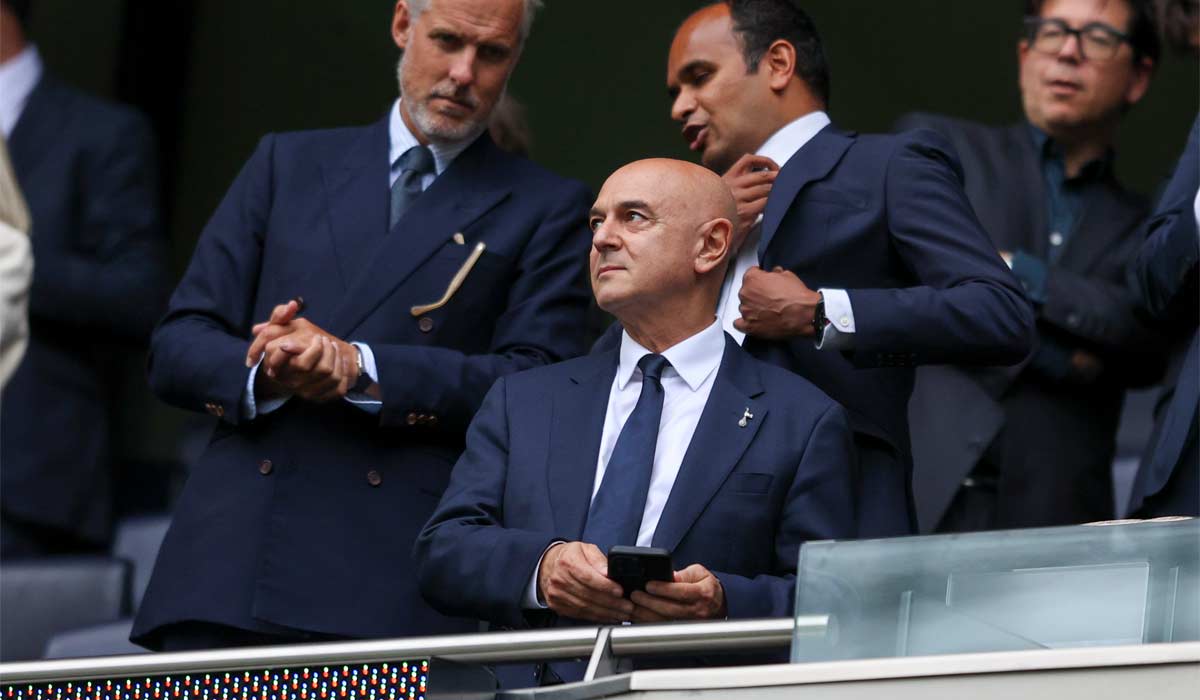
Every club has its scapegoat, and few are as well-known as Daniel Levy. Regardless of affiliation, every fan seemed to have an opinion of the Tottenham Hotspur chairman, who left his position on Thursday after 24 years at the helm. Truthfully, reviews were rarely glowing. For many of those 24 years, Levy was the face of what Spurs had not achieved – one EFL Cup, one UEFA Europa League title, and a single appearance in the UEFA Champions League final over two decades – many would consider these rather meager returns, depending on who you ask. As Levy exits Tottenham, however, he leaves behind a complex legacy, complicated by the fact that much actually went right during his tenure at the club.
Levy, the longest-serving club chairman in the Premier League, might primarily be remembered for his longevity – a tenacity that made his departure a genuine shock. His lengthy spell in charge of Spurs, though, serves as a clear snapshot of the club`s unexpected journey over the last two decades.
Long before Spurs` trophy cabinet became a common topic of social media discussion, Levy took over as the club`s executive chairman in February 2001 after acquiring British business magnate Alan Sugar`s 27% stake. Talk of trophies was, to put it mildly, aspirational when Levy took charge. Tottenham might have been one of the `big five` clubs that helped form the Premier League, yet immediate prestige eluded the North London club. They hadn`t finished higher than seventh since the Premier League`s inaugural 1992-93 season, sometimes finding themselves closer to the relegation zone (15th the following season) than to a title challenge.
Success wasn`t instant, but within a few years, Spurs` upward trajectory became clear for all to see. Tottenham achieved a fifth-place finish in the 2005-06 season, partly due to Robbie Keane`s career-best 16-goal campaign, even if things unraveled due to a food poisoning incident affecting the team before a crucial game against West Ham United, with fourth place on the line. However, their participation in the UEFA Cup (now known as the Europa League) the following season marked Levy`s crowning achievement: Spurs participated in European competitions in 18 of the last 20 seasons, a streak previously unknown to the team.
This demonstrated Tottenham`s consistency under Levy, as the club became increasingly adept at attracting talented players like Dimitar Berbatov and Gareth Bale. While both may have departed for greater chances at silverware, their new clubs sent substantial transfer fees in return. Levy`s Spurs have since been caught in a kind of purgatory, a club on the cusp of elite status, often feeling like a dark horse contender for silverware yet consistently reminded of its second-tier position in football`s hierarchy. This doesn`t mean Levy`s most recognizable strategy wasn`t effective; for the majority, sports aren`t solely about winning titles, as breaking into the elite is easier said than done. In football terms, most clubs are `selling clubs,` and it can be argued that Levy`s Spurs were among the best in this category. Even as figures like Luka Modric and Kyle Walker left, Tottenham recruited well enough that maintaining their spot in European competition was almost a given. They may have been fortunate with academy product Harry Kane, but players like Son Heung-min, Toby Alderweireld, and Christian Eriksen left their own significant mark, particularly as staples of Mauricio Pochettino`s 2018-19 team that reached the Champions League final.
However, Levy`s most visible legacy will undoubtedly be the 62,000-seat Tottenham Hotspur Stadium. This venue perfectly encapsulates Spurs` rise, with the club now successful enough to warrant a state-of-the-art stadium that regularly generates revenue from NFL games and concerts as secondary functions. By the time the new stadium opened in 2019, a rarely-seen trajectory was complete: Spurs had climbed out of mid-table mediocrity to become one of the sport`s most recognizable clubs, all without cash injections from a nation-state or a businessperson with remarkably deep pockets. Levy achieved this incredible feat without a pre-existing blueprint, during an era when massive capital flooded the sport, occasionally propelling Spurs` main competitors to unprecedented heights.
In essence, Levy built a club that was too large for one person to run.
If there was clamor that Spurs` balance sheet looked too “healthy” before the run to the Champions League final, the noise reached a fever pitch afterward. Tottenham`s current squad has almost paled in comparison to Pochettino`s version of the team, which finished in the Premier League`s top three in three of the five full seasons he was at the helm. Contrary to popular belief, this isn`t due to Levy`s lack of interest in spending on new signings. Tottenham hasn`t generated a profit in the transfer market over the last five years, incurring a net spend deficit of approximately $760 million, the fourth-highest in the league. The top eight players on their record signings list joined the club after the Champions League final run, including new chart-topper Xavi Simons.
How well the club spent on new signings, however, is an entirely different story. Clubs can no longer function as single-person operations, especially not the richest and most successful ones. The demands of building the stadium may have kept Levy away from the transfer market to the extent that Spurs signed no players in the summer of 2018, but he wasn`t the only one pulling the strings at Spurs in his final days. That said, it took too long for a modern structure to take hold. Sporting directors came and went with varying levels of influence; the situation seemingly shifted only with the arrival of Fabio Paratici in 2021 and Johan Lange in 2023, who took the role after Paratici received a 30-month ban due to an accounting scandal during his tenure at Juventus. This means Spurs are still playing catch-up with clubs like Liverpool and Manchester City, which have had robust sporting departments for several years, and won`t be able to keep pace until they improve their player recruitment strategy.
This wasn`t the only questionable decision Levy made in his final years at the club, though he is, sadly, far from unique in this category. Tottenham is among several English clubs that have been reluctant to further invest in women`s football, despite the undeniable surge in the sport`s popularity fueled by the Lionesses` consecutive European Championship victories. Barcelona`s trajectory from a professional team in 2015 to UEFA Women`s Champions League winners in 2021 should signal to Europe`s power players that breaking into the upper echelons of the women`s game is more than feasible. There may be signs of optimism for Spurs` women`s team, though: new CEO Vinai Venkatesham advocated for Arsenal`s women`s team during his time at that club, with the fruits of that labor manifesting in their 2025 UWCL triumph.
Any fair criticism of Levy is rooted in the fact that the job of running Tottenham was too big for one person, with several important tasks falling by the wayside in his final years at the club. This implies that his reported removal by Spurs` majority shareholders was perhaps deserved, if bold, because Levy felt like a permanent fixture at the club. It may be no consolation to him at this juncture, but his perceived failures are, in fact, a testament to a job well done. Levy is arguably the sole executive of his kind in sports to have single-handedly transformed a club without a blank check from ownership, a feat perhaps the most impossible in this new age of sports commercialization.